

Management Methods and Learning Skills That Actually Work in the Real World
Most people treat management and learning as two separate disciplines. Zeb’s article draws on a decade of leading over 10 multidisciplinary teams and working alongside over 300 professionals to challenge this assumption. Based on real-world experience in security, deep-tech startups, and his own ventures, this article provides the frameworks, lessons, and tools that no business school teaches, but that every leader ultimately learns the hard way.
By Nadav LevY | Deep-Tech Entrepreneur & R&D Leader | Founder, EN SignalTouch
Most people treat management and learning as two separate disciplines. Managers read about frameworks. Students study theory. And then both groups step into the real world and discover that what they studied rarely matches what they face.
After leading more than ten multidisciplinary R&D teams and working alongside over three hundred professionals in defense, deep-tech startups, and my own ventures, I have come to a single conclusion: the gap between knowing and doing is the most expensive gap in any organization.
This article is for the people who are done with theory and ready for tools that work under pressure, in real environments, with real stakes.
Part One: What Management Actually Is (And What Most People Get Wrong)
The most common mistake I see in new managers is confusing management with control. They assume that their job is to oversee tasks, track outputs, and make sure everything is done on time. And technically, they are not wrong. But technically correct management is also how you build a team that does the minimum required and nothing more.
Real management is about creating the conditions for people to do their best work. That is a fundamentally different job description. It requires you to understand what each person on your team needs in order to think clearly, act confidently, and grow beyond what they thought they were capable of.
The Three Roles Every Manager Plays Simultaneously
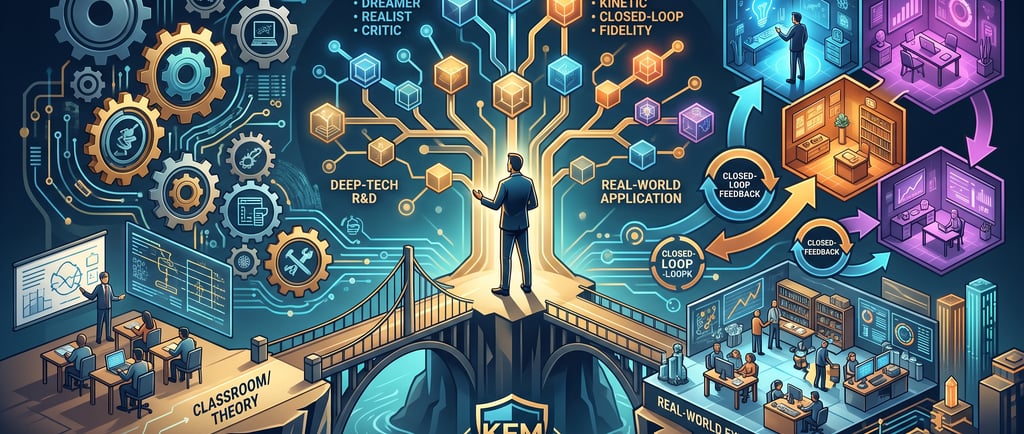
Walt Disney built his creative empire around a framework that I believe is the most honest description of what effective leadership actually looks like. He called it his three rooms. In each room, he operated from a completely different mindset:
The Dreamer: the person who imagines without limits, who asks what could exist that does not yet exist, and who refuses to let current constraints define future possibilities.
The Realist: the person who takes the dream and turns it into a structured plan, a timeline, a set of actions that actual humans can execute on a Monday morning.
The Critic: the person who stress-tests the plan, identifies the risks, asks the uncomfortable questions, and ensures that the execution will survive contact with reality.
The most effective managers I have worked with carry all three of these voices and know when to let each one speak. They do not let the Critic kill the dream before it has room to breathe. They do not let the Dreamer skip past the hard work of planning. And they do not let the Realist become so focused on execution that the original vision gets lost.
Managing Teams vs. Developing People
There is a distinction that separates average managers from exceptional ones, and it is deceptively simple: managing teams is about making sure the work gets done. Developing people is about giving them the thinking tools, the learning skills, and the perspective to see beyond their own domain.
I learned this lesson the hard way. I once led a technically brilliant R&D team where the hardware engineers never talked to the software engineers, the QA team was testing something that no longer matched what development had built, and every individual was performing well while the system as a whole was failing.
The problem was not technical. It was that I had been managing outputs instead of building people who could see the whole picture. When I shifted my focus from deliverables to capabilities, the team transformed. Engineers started asking questions they had never asked before. Silos dissolved not because I ordered them to, but because the people inside them had developed the curiosity and the confidence to reach across them.
Part Two: The Learning Skills That Separate High Performers from Everyone Else
In a world where AI can retrieve any piece of knowledge in seconds, the scarcity is no longer information. The scarcity is the ability to do something meaningful with it. The people who will thrive in the next decade are not the ones who know the most. They are the ones who have developed the skills to learn faster, adapt quicker, and build new capability in conditions that have no instruction manual.
Kinetic Learning: Why Doing Beats Studying Every Time
Most educational systems are built around the assumption that you study first and apply later. You absorb the theory, you pass the test, and then you go use what you have learned in the real world. This model made sense when information was scarce and stable. It does not make sense in a world where both conditions have reversed.
Knowledge stored in your head and knowledge activated under pressure are two completely different things. I have seen this gap destroy otherwise talented people in high-stakes environments. They could explain the concept perfectly in a classroom. They could not adapt when the edge case appeared, the timeline collapsed, or the team disagreed on the fundamental approach.
The solution is what I call Kinetic Learning: the practice of embedding knowledge through real-time problem solving, eliminating the gap between theory and application. It is not learning by watching. It is learning by moving. Building the skill through the friction of real execution, not the comfort of passive consumption.
In practice, this means giving people problems before you give them solutions. It means creating environments where failure at the edge of capability is expected and analyzed rather than avoided and punished. It means treating every project as a learning system, not just a delivery mechanism.
The Closed-Loop Feedback System
The fastest learners I have worked with share one habit: they close the loop between action and reflection. They do something, they observe what happened, they extract the principle, and they apply it immediately to the next iteration. This is not a natural tendency. It is a discipline that has to be built deliberately.
Building a closed-loop learning system in your team or your own practice looks like this:
Act at the edge of your current capability, not in the comfort zone of what you already know.
Observe the outcome with genuine curiosity rather than defensive justification.
Extract the principle: what does this outcome tell you about how the system actually works?
Apply the principle immediately in the next iteration, before the insight fades.
Fidelity: The Discipline of Precision in Skill Development
The second principle of high-performance learning is what I call Fidelity: the commitment to maximum precision in skill acquisition by removing the noise that prevents real mastery. Most learning environments are full of noise. Irrelevant information, unclear standards, inconsistent feedback, and social pressure to perform rather than to learn.
High-fidelity learning means being ruthlessly specific about what skill you are developing, what good looks like, and what signals tell you whether you are getting closer or drifting further. It means creating environments where the signal is clear and the noise is eliminated, so that every hour of practice builds genuine capability rather than the illusion of it.
Part Three: What No One Tells You About Leading High-Stakes Teams
Business schools teach you how to analyze a case study. Nobody teaches you what to do when you are the case study. After years of leading teams through complex, high-pressure environments, I have identified a set of skills that are almost never formally taught but consistently separate great leaders from good ones.
Making Decisions With Incomplete Information
Every case study comes with a complete dataset. Real leadership happens in the gap between the data you have and the decision that cannot wait. The ability to move forward under genuine uncertainty, own the outcome, and adjust without losing the team's confidence is a skill that only experience builds. The leaders I have seen fail under pressure are almost always the ones who were waiting for certainty before acting. The ones who succeeded had learned to make the best decision available with what they knew, commit fully, and stay open to adjusting without treating adjustment as failure.
The Communication Gap That Kills Great Ideas
I once watched one of my engineers present a technically extraordinary idea to senior leadership and leave the room without approval. Not because the idea was wrong. Because he spoke the language of engineering in a room that only understood the language of impact.
He explained how it worked. Nobody in that room needed to know how it worked. They needed to know why it mattered, what problem it solved, and what would happen if it did not get built. I took the same idea back to leadership a few weeks later with a different frame. Same technology. Different story. They approved it immediately. That engineer went on to build one of the most important solutions I have ever seen.
The lesson: being technically excellent is not enough. You have to be able to translate your expertise into language that moves people to act. That is not a soft skill. It is the skill that determines whether your best ideas survive contact with the people who have the power to fund them.
The Loneliness of Leadership (And How to Navigate It)
Nobody tells you about the loneliness of leadership before you get there. The higher you climb, the smaller the circle of people you can talk to openly. The colleagues who used to be peers become direct reports. The friendships that were built on honesty get filtered through the dynamics of hierarchy. And the decisions that carry the most weight are often the ones you have to carry alone.
Three things have helped me navigate this consistently:
Build a peer network outside your organization of people at a similar level who can hold the real conversation without the politics.
Get comfortable sitting with uncertainty alone. Not every decision has someone to consult. That is not a failure of leadership. It is the definition of it.
Distinguish between the loneliness that comes from the role and the isolation that comes from avoiding vulnerability. The first is inevitable. The second is a choice.
Part Four: Building a Culture Where Learning and Performance Reinforce Each Other
The organizations that consistently outperform over time are not the ones with the best talent. They are the ones where learning and performance are not in tension but are designed to reinforce each other. Where failure is treated as data rather than evidence of inadequacy. Where the best ideas win regardless of who they came from. Where people are developed rather than managed.
Building this kind of culture requires a deliberate commitment to three things. First, psychological safety: people need to know that raising a concern, admitting a mistake, or challenging an assumption will not end their career or their relationship with you. Second, a shared language for learning: the team needs common frameworks for how they extract lessons from experience, share insights across domains, and build on each other's knowledge rather than competing with it. Third, systems that reward learning, not just outputs: if the only thing you measure and celebrate is delivery, you will get delivery at the expense of growth.
The most powerful signal you can send as a leader is to model the learning behavior you want to see. Share what you got wrong. Explain how your thinking changed. Ask for feedback from people who have less experience than you. When you do this consistently, you give everyone around you permission to do the same.
Conclusion: The Person You Become While Building Is the Real Product
After everything I have built, the thing I am most proud of is not the technology I have developed, the teams I have led, or the ventures I have founded. It is who I became in the process of building all of it.
The projects that succeeded taught me discipline. The ones that failed taught me judgment. The teams I led well taught me what good leadership feels like from the inside. The teams I led poorly taught me what it costs when you get it wrong. Every difficult conversation, every decision with incomplete information, every moment of carrying something alone that I could not share: all of it built a kind of capability that no course, certification, or degree could have given me.
The 22nd century will not reward what you know. It will reward how you learn, how fast you adapt, and how well you can build new capability in conditions that have no instruction manual. Management methods matter. Learning skills matter. But what matters most is the commitment to keep developing both, long after the formal education ends.
The question is not whether you have the right knowledge. The question is whether you have built the right relationship with learning itself.
EN SignalTouch
123-456-7890
info@email.com